6 posts tagged with "Stellar"

Stellar network and cross-border payments

View all tags

Amundi's SAFO Hit $400M in Three Weeks — Institutional Tokenization Just Crossed the Point of No Return

· 8 min read
Dora Noda
Software Engineer

BlackRock took months to grow its BUIDL tokenized fund to $500 million. Franklin Templeton's BENJI needed over three years to hit $800 million. In March 2026, Amundi and Spiko launched SAFO — and crossed $400 million in assets under management in 21 days.

That speed is not a marketing footnote. It is a signal that the institutional tokenization era has decisively shifted from "intriguing pilot" to "proven product category."

Amundi's $400M in 21 Days: Why SAFO Just Rewrote the Institutional Tokenization Playbook

· 12 min read
Dora Noda
Software Engineer

In less than three weeks, a new tokenized fund pulled in $400 million. It didn't come from a crypto-native issuer, a Cayman Islands structure, or a yield-farming campaign. It came from Amundi — Europe's largest asset manager, steward of €2.3 trillion, the kind of institution that usually takes years to launch anything on a blockchain.

That fund, the Spiko Amundi Overnight Swap Fund (SAFO), went live on March 19, 2026. By early April, it had quadrupled from its $100 million opening AUM and surpassed BlackRock's BUIDL as the fastest-growing tokenized fund on Chainlink infrastructure. The number matters less than what it proves: institutional tokenization has exited the pilot phase. The distribution engines are plugged in, the regulators have signed off, and the capital is moving at a velocity that earlier RWA launches couldn't dream of.

This is the story of how SAFO's 21-day sprint exposed the real bottleneck in tokenized finance — and why the winners of the next five years will be determined by distribution, not technology.

The $400 Million Sprint That Nobody Saw Coming

Let's put SAFO's trajectory in context. BlackRock's BUIDL, launched in March 2024, took months to cross $500 million. It currently sits near $2 billion AUM after roughly two years of institutional grind. Franklin Templeton's BENJI, a product many consider the pioneer of on-chain money market funds, is hovering around $800 million after launching in 2021. Ondo's OUSG, designed natively for the DeFi crowd, has built its book slowly and deliberately.

SAFO blew past every one of those growth curves in 21 days.

The launch structure itself was calibrated for speed. Amundi and Spiko opened subscriptions in four currencies — EUR, USD, GBP, and CHF — with a minimum investment of just one unit of currency. That single design choice matters more than any blockchain decision. It means a corporate treasurer in London, a family office in Zurich, and a fintech startup in Paris can all enter the same fund on the same day, in their home currency, with no minimum friction. Most tokenized funds gate access behind $100,000+ thresholds and a single settlement currency. SAFO kicked that gate open.

The UCITS wrapper did the other half of the lifting. As a tokenized sub-fund of SPIKO SICAV, regulated by the French AMF, SAFO is legally the same instrument European institutional investors already buy. There's no new category for compliance officers to interpret, no fresh risk assessment to write, no memo to circulate explaining why this thing is safe to hold. That regulatory familiarity collapses the adoption timeline from "quarters of evaluation" to "days of execution."

The Distribution Thesis Gets Its Proof

Crypto-native builders have spent the last three years arguing that better technology — higher throughput, lower fees, more programmability — would drive tokenization adoption. SAFO suggests the opposite. The bottleneck was never the rails. It was access to the people with money.

Amundi's 2025 annual report disclosed that digital distribution alone generated €10 billion of net inflows, representing roughly half of total retail flows. The firm operates across 35+ countries, serves over 100 million retail clients through partnerships with more than 100 banks, and maintains the deepest corporate treasury relationships in continental Europe. When Amundi announces a new fund, it doesn't need to build an audience. It already owns one.

Compare that to BUIDL's distribution path. BlackRock had to court crypto-native counterparties one by one — Ondo, Ethena, Circle, Securitize — because its traditional client base was still completing due diligence on whether tokenized products fit their mandates. The fund's growth came from inside the crypto ecosystem recycling capital into institutional-grade collateral. That's valuable, but it caps the addressable market at what DeFi protocols and treasuries are willing to park on-chain.

SAFO hit a different pool. Its inflows came from:

  • Corporate treasurers seeking overnight liquidity above risk-free benchmarks, now with the optionality of 24/7 transfer and API-programmable cash management
  • Asset managers running short-duration strategies that benefit from composable collateral across chains
  • Financial institutions using SAFO shares as tokenized collateral for swaps and repos — a use case that only exists once the product is both regulated and on-chain

Each of these segments already has an Amundi relationship. The tokenization simply exposed a new shelf in a store where the customers were already shopping.

Why Two Chains, Not One

SAFO deploys on both Ethereum and Stellar. The architectural choice deserves attention because it breaks with the assumption that institutional issuers will consolidate around a single settlement layer.

Ethereum gets the composability vote. If a DeFi protocol wants to accept SAFO shares as collateral, build a liquidity vault around them, or integrate them into a tokenized structured product, that workflow lives on Ethereum's smart contract ecosystem. The addressable integration surface — lending protocols, stablecoin issuers, on-chain insurance — is still overwhelmingly Ethereum-first.

Stellar gets the payments vote. Stellar's near-zero transaction fees and multi-currency settlement design make it a natural rail for cross-border treasury movements and collateral swaps where gas costs on Ethereum would eat into yield. For a fund offering balances denominated in four currencies, Stellar's built-in multi-currency token standard removes friction that Ethereum would require wrapped-asset contracts to solve.

Chainlink's CCIP stitches the two together. SAFO holders can move between Ethereum and Stellar deployments as market conditions demand, with Chainlink providing the on-chain NAV oracle that keeps both sides of the system accounting to the same source of truth. This is the first production example of a tokenized mutual fund operating natively across multiple public blockchains — an important precedent, because it formalizes the idea that "which chain" is no longer a binding decision for institutional product design.

Chainlink's numbers tell their own story. CCIP processed more than $18 billion in cross-chain transfer volume during March 2026 — a 62% jump from February — with daily averages north of $600 million. The interop layer has quietly become the institutional plumbing, not the speculative one.

The Swap Structure Is the Real Innovation

Headlines have focused on SAFO's AUM growth, but the fund's underlying mechanism deserves equal attention. SAFO does not hold government bonds directly. Instead, it enters fully collateralized total return swaps with Tier-1 banking counterparties — including BNP Paribas, Goldman Sachs, JP Morgan, UBS, Barclays, Citi, and Morgan Stanley — to deliver yields above the risk-free benchmark while maintaining overnight liquidity.

Why this matters: traditional tokenized money market funds like BUIDL, BENJI, and OUSG own underlying Treasury securities. That works well, but it inherits the settlement limitations of those instruments. A swap-based structure decouples the yield source from the settlement rail. SAFO can offer daily redemptions, multi-currency subscriptions, and programmatic liquidity because the bank counterparties absorb the operational complexity of the underlying portfolio.

It's also a clue about where institutional tokenization is heading. The first wave tokenized assets — wrap a Treasury bond on-chain, call it progress. The second wave is tokenizing financial relationships — counterparty exposure, swap receivables, collateral claims — and letting the blockchain serve as the transparent ledger rather than the asset itself. SAFO is an early example of that shift, and it's the reason Tier-1 banks agreed to sit on the other side of the trade.

The New Competitive Landscape

With SAFO's arrival, the tokenized money market fund sector now has a four-way race with distinctly different distribution strategies:

BlackRock BUIDL (~$2B): Dominant in crypto-native distribution. Deep integrations with stablecoin issuers, DeFi protocols, and centralized exchanges. Growth depends on continued maturation of on-chain institutional collateral markets.

Franklin Templeton BENJI (~$800M): Longest-tenured. Pioneered tokenized registry approach — one share equals one token, with the blockchain serving as the authoritative shareholder database. Growth has been steady but constrained by Franklin's retail-heavy distribution not yet fully activated.

Ondo OUSG: Crypto-native by design. Built for DeFi composability first, institutional access second. Benefits from the Ondo-Chainlink oracle integration across tokenized stocks and treasuries.

Amundi SAFO ($400M): Distribution-first, leveraging Europe's largest asset manager to reach corporate treasuries and professional investors. Multi-currency and multi-chain from day one. Swap-based yield mechanism rather than direct Treasury holdings.

None of these four are strictly competing for the same capital today. BUIDL wins where DeFi protocols need on-chain collateral. BENJI wins where long-tenure regulatory trust matters. Ondo wins where composability is the primary requirement. SAFO wins where European institutional and corporate distribution trumps crypto-native features. But as the total tokenized RWA market grows toward BCG's $16 trillion 2030 projection — from roughly $27 billion in April 2026 — these distribution moats will start colliding. The question is whether any single issuer can build the multi-geography, multi-currency, multi-chain footprint that captures all four buyer types.

Amundi's position looks the strongest today. The firm's €2.3 trillion AUM dwarfs BlackRock's tokenization allocations, Franklin's total book, and Ondo's entire addressable market combined. If Amundi commits even 1% of its existing AUM to tokenized vehicles, it adds $23 billion to the sector — nearly doubling today's total tokenized RWA market in a single push.

The Infrastructure Lesson for Builders

SAFO's growth carries a specific message for anyone building on the RWA thesis: the infrastructure layer is mature enough that product-market fit now depends on distribution, not protocol engineering.

Chainlink's CCIP, Proof of Reserve, and NAV oracle services handled SAFO's cross-chain accounting with no custom smart contract development. Spiko's platform provided the issuance, custody, and compliance wrapper. Ethereum and Stellar provided the settlement rails. Amundi provided the fund structure, the regulatory shell, and — most importantly — the clients.

Every one of those layers is available to other issuers. What's scarce is the client base. The builders who win the next decade of RWA will either acquire that distribution (acquisitions, partnerships, white-label deals with traditional asset managers) or accept being infrastructure vendors to the issuers who already have it.

For developers building on these institutional tokenization rails, reliable multi-chain infrastructure has become table stakes. BlockEden.xyz provides enterprise-grade RPC and indexing APIs across Ethereum, Sui, Aptos, and 20+ other chains — the kind of infrastructure tokenized products depend on to deliver the 24/7 availability institutional clients expect. Explore our API marketplace to build on the same foundations powering the next wave of on-chain finance.

What Comes Next

Three things to watch as SAFO's growth curve continues:

Currency expansion. The fund launched in four currencies. Spiko has signaled plans to broaden access through its API-enabled distribution network. Adding JPY, SGD, or HKD would open Asian institutional markets where tokenization interest has been rising but compliant products remain scarce.

Composability integrations. SAFO shares are tokenized, but the question is whether DeFi protocols will accept them as collateral. The UCITS wrapper provides regulatory clarity, but smart contract integration is a separate technical hurdle. If Aave, Maker, or a major tokenized stablecoin accepts SAFO shares in the next six months, the fund's utility expands from "tokenized cash" to "yield-bearing on-chain collateral" — a meaningfully larger addressable market.

Follow-on launches. Amundi now has proof that its clients will move billions into tokenized products at speed. Expect additional fund tokenizations across equity, bond, and multi-asset strategies throughout 2026. The question isn't whether Amundi continues — it's whether BlackRock, Vanguard, and State Street respond by accelerating their own tokenization roadmaps or risk ceding the distribution edge.

The broader signal is clear. Tokenization stopped being a pilot program when a $2.3 trillion asset manager pulled $400 million on-chain in three weeks without promising yield above market, without running an airdrop, and without courting a single crypto-native buyer. The product just worked. The clients just showed up.

For the rest of the industry, that's either an opportunity to partner with the distribution giants — or a warning that the next phase of tokenization will be played on their terms, not yours.

Sources

x402 Protocol: How a Forgotten HTTP Status Code Became the Payment Rail for 154 Million AI Agent Transactions

· 9 min read
Dora Noda
Software Engineer

In 1997, the architects of the World Wide Web reserved HTTP status code 402 — "Payment Required" — for future use. Nearly three decades later, that placeholder has become the foundation of a protocol processing over 154 million transactions and $600 million in annualized volume. The x402 protocol, launched by Coinbase and now backed by a foundation that includes Cloudflare, Google, and Visa, is quietly turning every API endpoint on the internet into a monetizable service — and AI agents are its first and fastest-growing customers.

Configuration Errors Eclipse Code Vulnerabilities

· 9 min read
Dora Noda
Software Engineer

An attacker posts 8 USDC as collateral and walks away with 187 ETH — roughly $390,000. The smart contracts worked exactly as designed. The oracle did its job. But someone plugged the BTC/USD Chainlink price feed into the slot meant for USDC. That single line of configuration turned a functioning lending protocol into a free-money machine.

Welcome to the new front line of DeFi security, where the deadliest vulnerabilities are not hiding in Solidity bytecode — they are sitting in admin dashboards, deployment scripts, and parameter files.

PayFi's $630B Remittance Play: How Blockchain Is Eating Western Union's Lunch

· 8 min read
Dora Noda
Software Engineer

When Remittix announced its six-layer PayFi Stack integrating Solana and Stellar for cross-border payments, Western Union didn't issue a press release. They launched their own Solana-based stablecoin. The $630 billion global remittance market—dominated by legacy players charging 5-10% fees and taking 3-5 days—faces disruption from Payment Finance protocols that settle in seconds for fractions of a cent. PayFi isn't just cheaper and faster. It's programmable, compliant, and accessible to the 1.4 billion unbanked adults excluded from traditional banking.
The acronym "PayFi" combines "Payment" and "Finance," describing blockchain-based payment infrastructure with programmable features impossible in legacy systems. Unlike stablecoins (static value transfer) or DeFi (speculative finance), PayFi targets real-world payments: remittances, payroll, invoicing, and merchant settlements. The sector's emergence threatens Western Union, MoneyGram, and traditional banks that extract billions annually from migrants sending money home.

The $630B Remittance Market: Ripe for Disruption

Global remittances reached $630 billion annually, with the World Bank projecting growth to $900 billion by 2030. This market is massive, profitable, and inefficient. Average fees hover around 6.25% globally, with some corridors (Sub-Saharan Africa) charging 8-10%. For a Filipina worker in Dubai sending $500 monthly home, $30-50 disappears to fees. Over a year, that's $360-600—meaningful money for families relying on remittances for survival.

Settlement times compound the problem. Traditional wire transfers take 3-5 business days, with weekends and holidays adding delays. Recipients can't access funds immediately, creating liquidity crunches. In emergencies, waiting days for money arrival can mean disaster.

The user experience is archaic. Remittance senders visit physical locations, fill forms, provide IDs, and pay cash. Recipients often travel to collection points. Digital alternatives exist but still route through correspondent banking networks, incurring fees at each hop.

PayFi protocols attack every weakness:

  • Fees: Blockchain transactions cost $0.01-0.50, not 5-10%
  • Speed: Settlement in seconds, not days
  • Accessibility: Smartphone with internet, no bank account required
  • Transparency: Fixed fees visible upfront, no hidden charges
  • Programmability: Scheduled payments, conditional transfers, smart escrow

The economics are brutal for legacy players. When blockchain alternatives offer 90% cost reduction and instant settlement, the value proposition isn't marginal—it's existential.

Remittix and Huma's PayFi Stack: The Technical Innovation

Remittix's six-layer PayFi Stack exemplifies the technical sophistication enabling this disruption:

Layer 1 - Blockchain Settlement: Integration with Solana (speed) and Stellar (remittance-optimized) provides redundant, high-performance settlement rails. Transactions finalize in 2-5 seconds with sub-cent costs.

Layer 2 - Stablecoin Infrastructure: USDC, USDT, and native stablecoins provide dollar-denominated value transfer without volatility. Recipients receive predictable amounts, eliminating crypto price risk.

Layer 3 - Fiat On/Off Ramps: Integration with local payment providers enables cash-in and cash-out in 180+ countries. Users send fiat, blockchain handles middle infrastructure, recipients get local currency.

Layer 4 - Compliance Layer: KYC/AML checks, transaction monitoring, sanctions screening, and reporting ensure regulatory compliance across jurisdictions. This layer is critical—without it, financial institutions won't touch the platform.

Layer 5 - AI-Driven Risk Management: Machine learning models detect fraud, assess counterparty risk, and optimize routing. This intelligence reduces chargebacks and improves reliability.

Layer 6 - API Integration: RESTful APIs enable businesses, fintechs, and neobanks to embed PayFi infrastructure without building from scratch. This B2B2C model scales adoption faster than direct-to-consumer.

The stack isn't novel in individual components—stablecoins, blockchain settlement, and compliance tools all exist. The innovation is integration: combining pieces into a cohesive system that works across borders, currencies, and regulatory regimes at consumer scale.

Huma Finance complements this with institutional-grade credit and payment infrastructure. Their protocol enables businesses to access working capital, manage payables, and optimize cash flow using blockchain rails. Combined, these systems create end-to-end PayFi infrastructure from consumer remittances to enterprise payments.

Western Union's Response: If You Can't Beat Them, Join Them

Western Union's announcement of USDPT stablecoin on Solana validates the PayFi thesis. A 175-year-old company with 500,000 agent locations globally doesn't pivot to blockchain because it's trendy. It pivots because blockchain is cheaper, faster, and better.

Western Union processes $150 billion annually for 150 million customers across 200+ countries. The company compared alternatives before selecting Solana, citing its ability to handle thousands of transactions per second at fractions of a cent. Traditional wire infrastructure costs dollars per transaction; Solana costs $0.001.

The economic reality is stark: Western Union's fee revenue—their core business model—is unsustainable when blockchain alternatives exist. The company faces a classic innovator's dilemma: cannibalize fee revenue by adopting blockchain, or watch startups do it instead. They chose cannibalization.

USDPT targets the same remittance corridors PayFi protocols attack. By issuing a stablecoin with instant settlement and low fees, Western Union aims to retain customers by matching upstart economics while leveraging existing distribution networks. The 500,000 agent locations become cash-in/cash-out points for blockchain payments—a hybrid model blending legacy physical presence with modern blockchain rails.

However, Western Union's structural costs remain. Maintaining agent networks, compliance infrastructure, and legacy IT systems creates overhead. Even with blockchain efficiency, Western Union can't achieve PayFi protocols' unit economics. The incumbents

' response validates the disruption but doesn't eliminate the threat.

The Unbanked Opportunity: 1.4 Billion Potential Users

The World Bank estimates 1.4 billion adults globally lack bank accounts. This population isn't uniformly poor—many have smartphones and internet but lack access to formal banking due to documentation requirements, minimum balances, or geographic isolation.

PayFi protocols serve this market naturally. A smartphone with internet suffices. No credit checks. No minimum balances. No physical branches. Blockchain provides what banks couldn't: financial inclusion at scale.

The use cases extend beyond remittances:

Gig economy payments: Uber drivers, freelancers, and remote workers receive payments instantly in stablecoins, avoiding predatory check-cashing services or waiting days for direct deposits.

Merchant settlements: Small businesses accept crypto payments and receive stablecoin settlement, bypassing expensive merchant service fees.

Microfinance: Lending protocols provide small loans to entrepreneurs without traditional credit scores, using on-chain transaction history as creditworthiness.

Emergency transfers: Families send money instantly during crises, eliminating waiting periods that worsen emergencies.

The addressable market isn't just $630 billion in existing remittances—it's the expansion of financial services to populations excluded from traditional banking. This could add hundreds of billions in payment volume as the unbanked access basic financial services.

AI-Driven Compliance: Solving the Regulatory Bottleneck

Regulatory compliance killed many early crypto payment attempts. Governments rightly demand KYC/AML controls to prevent money laundering and terrorism financing. Early blockchain payment systems lacked these controls, limiting them to gray markets.

Modern PayFi protocols embed compliance from inception. AI-driven compliance tools provide:

Real-time KYC: Identity verification using government databases, biometrics, and social signals. Completes in minutes, not days.

Transaction monitoring: Machine learning flags suspicious patterns—structuring, circular flows, sanctioned entities—automatically.

Sanctions screening: Every transaction checks against OFAC, EU, and international sanctions lists in real-time.

Regulatory reporting: Automated generation of reports required by local regulators, reducing compliance costs.

Risk scoring: AI assesses counterparty risk, predicting fraud before it occurs.

This compliance infrastructure makes PayFi acceptable to regulated financial institutions. Banks and fintechs can integrate PayFi rails with confidence that regulatory requirements are met. Without this layer, institutional adoption stalls.

The AI component isn't just automation—it's intelligence. Traditional compliance relies on rules engines (if X, then flag). AI learns patterns from millions of transactions, detecting fraud schemes rules-engines miss. This improves accuracy and reduces false positives that frustrate users.

The Competitive Landscape: PayFi Protocols vs. Traditional Fintechs

PayFi protocols compete not just with Western Union but also with fintechs like Wise, Revolut, and Remitly. These digital-first companies offer better experiences than legacy providers but still rely on correspondent banking for cross-border transfers.

The difference: fintechs are marginally better; PayFi is structurally superior. Wise charges 0.5-1.5% for transfers, still using SWIFT rails in the background. PayFi charges 0.01-0.1% because blockchain eliminates intermediaries. Wise takes hours to days; PayFi takes seconds because settlement is on-chain.

However, fintechs have advantages:

Distribution: Wise has 16 million users. PayFi protocols are starting from zero.

Regulatory approval: Fintechs hold money transmitter licenses in dozens of jurisdictions. PayFi protocols are navigating regulatory approval.

User trust: Consumers trust established brands over anonymous protocols.

Fiat integration: Fintechs have deep banking relationships for fiat on/off ramps. PayFi protocols are building this infrastructure.

The likely outcome: convergence. Fintechs will integrate Pay Fi protocols as backend infrastructure, similar to how they use SWIFT today. Users continue using Wise or Revolut interfaces, but transactions settle on Solana or Stellar in the background. This hybrid model captures PayFi's cost advantages while leveraging fintechs' distribution.

Sources

BlockEden.xyz joins Stellar to bring the API of its new smart contract platform Soroban to developers

· 4 min read
Dora Noda
Software Engineer

We are excited to share that BlockEden.xyz is joining hands with Stellar, in order to empower developers worldwide. Stellar's blockchain platform has been a game-changer in quick and affordable cross-border transactions, while BlockEden.xyz's reliable API offerings for diverse DApps have positioned us as a key player across multiple blockchains. Together, we are poised to inspire a dynamic shift in the realms of blockchain and global finance.

What is Stellar

Stellar is an open-source, decentralized blockchain network designed to facilitate swift, low-cost cross-border transactions. Introduced in 2014 by Jed McCaleb, co-founder of Ripple and eDonkey, the Stellar network operates on a unique consensus protocol rather than the traditional proof-of-work or proof-of-stake mechanisms. People use Stellar network to build applications, issue assets, and build anchors (currency converters).

Stellar Soroban

Soroban is a smart contract platform that is integrated into the existing Stellar blockchain. Developers could develop smart contracts with a Rust dialect and interact with Stellar’s accounts and assets, not other operations like SDEX, AMMs, Claimable Balances, or Sponsorships.

The Soroban mainnet upgrade is scheduled for February 20th .

What is BlockEden.xyz

BlockEden.xyz is an API marketplace powering DApps of all sizes for Sui, Aptos, Solana, and 12 EVM blockchains. Why do our customers choose us?

  1. High availability. We maintain 99.9% uptime since our first API - Aptos main net launch.
  2. Inclusive API offerings and community. Our services have expanded to include Sui, Ethereum, IoTeX, Solana, Polygon, Polygon zkEVM, Filecoin, Harmony, BSC, Arbitrum, Optimism, Gnosis, Arbitrum Nova & EthStorage Galileo. Our community 10x.pub has 4000+ web3 innovators from Silicon Valley, Seattle, and NYC.
  3. Security. With over $45 million worth of tokens staked with us, our clients trust us to provide reliable and secure solutions for their web3 and blockchain needs.

We provide a comprehensive suite of services designed to empower every participant in the blockchain space, focusing on three key areas:

  • For blockchain protocol builders, we ensure robust security and decentralization by operating nodes and making long-term ecosystem contributions.
  • For DApp developers, we build user-friendly APIs to streamline development and unleash the full potential of decentralized applications.
  • For token holders, we offer a reliable staking service to maximize rewards and optimize asset management.

What is BlockEden.xyz building on Stellar and what does this mean for developers?

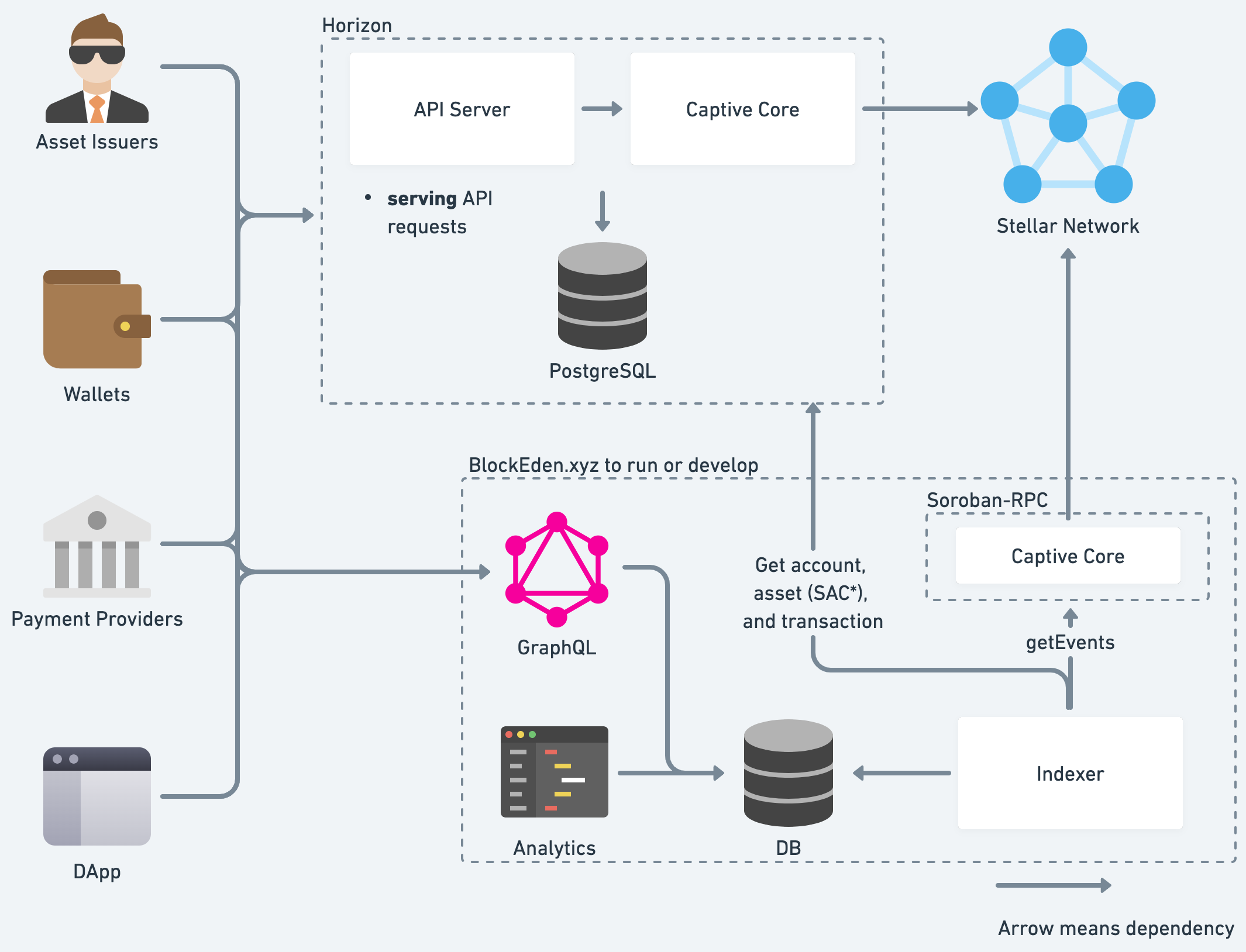
BlockEden.xyz is leveraging the Stellar network to offer commercial Soroban RPC and indexed data to help DApp developers to speed up development with a GraphQL API and analytics.

This comprehensive expansion into Stellar's infrastructure is set to present developers with more resources and tools, potentially facilitating easier adoption and more robust application development within the Stellar blockchain ecosystem.

Node operator and Indexer for Soroban RPC and Indexer GraphQL

As a node operator, BlockEden.xyz runs Soroban RPC, and then provides commercial standard RPCs to developers on the left. Unlike the official endpoints, our RPCs are equipped with rate limits and API meters tailored to developers’ tiered needs.

BlockEden.xyz also builds an indexer for contract data, tokens, events, etc. in the Soroban smart contract platform.

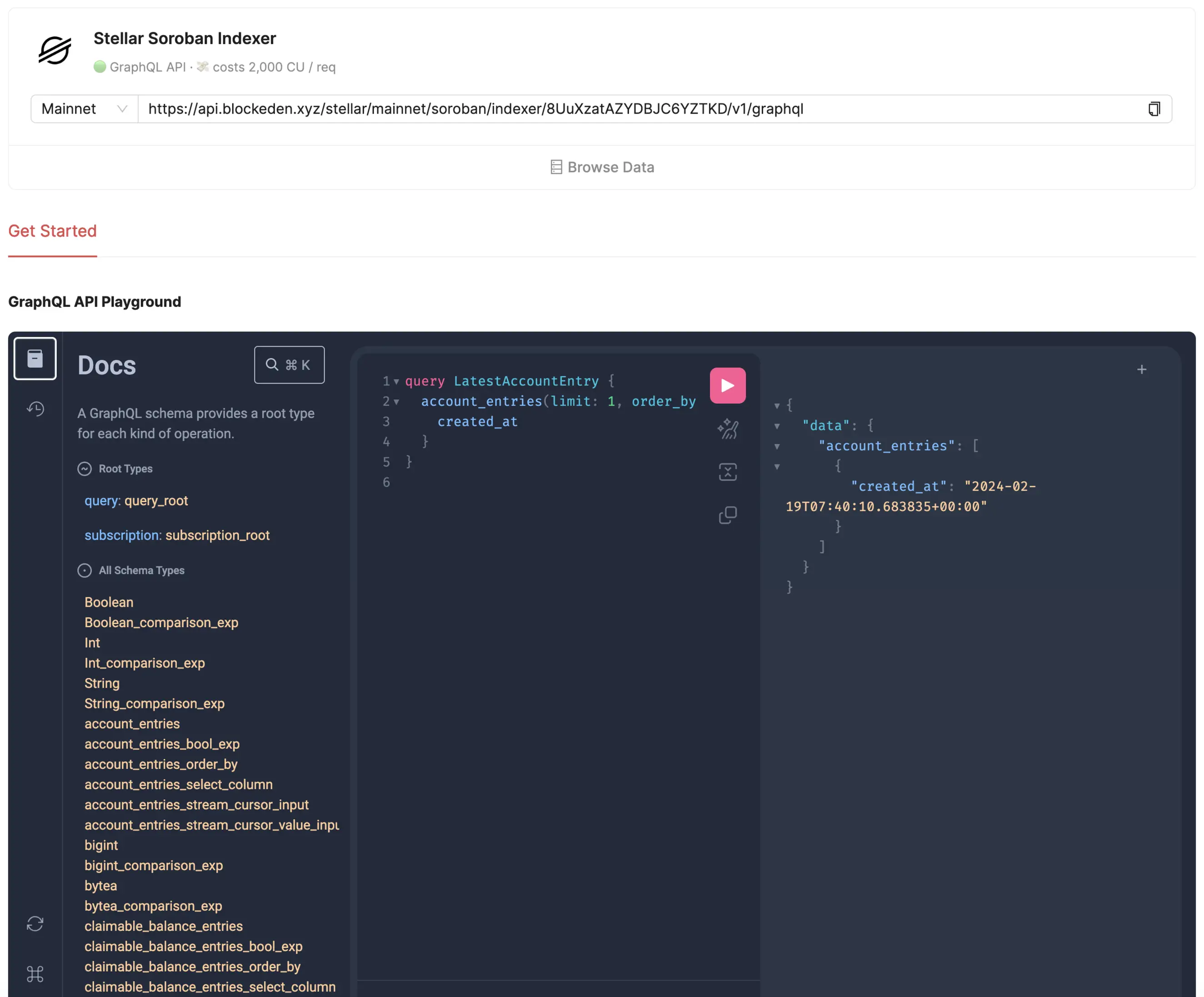
The index data will serve as GraphQL. The exact content of the index data is to be decided, though we will expose at least the developer-facing data models of the Horizon service.

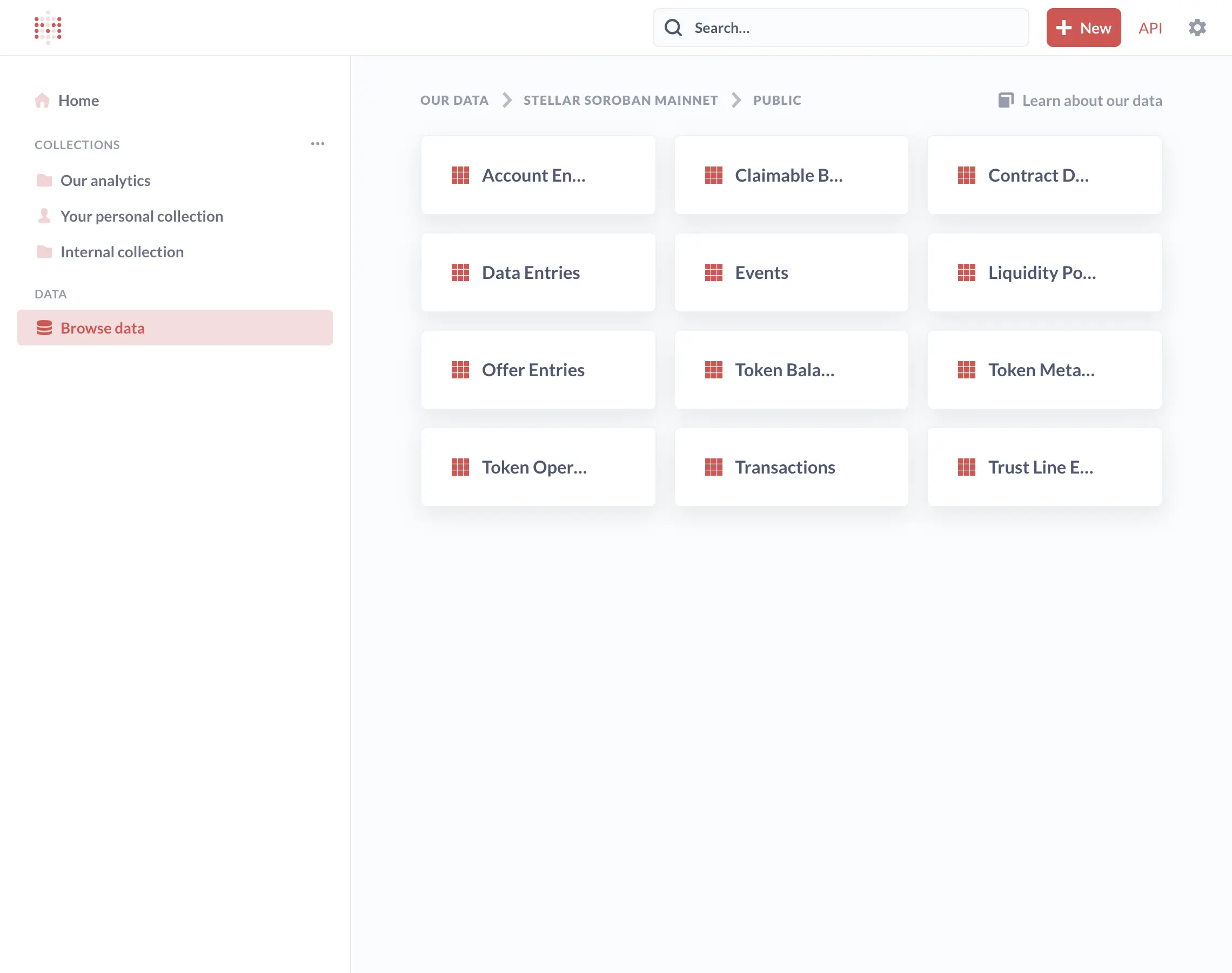
Business Intelligence / Analytics

Soroban RPC

For developer's convenience, we also serve the standard JSON RPC.

Conclusion

In conclusion, as we pave the way towards a new era in blockchain and global finance, our partnership with Stellar represents a significant milestone. Harnessing Stellar's swift, cost-effective transaction capabilities and BlockEden.xyz's high-quality API offerings, we are poised to create a paradigm shift in the way developers engage with the open money network. We hope this work will inspire innovations, trigger advancements, and propel us all towards a more connected and decentralized world. Here's to a future filled with endless possibilities and shared successes.