Can 0G’s Decentralized AI Operating System Truly Drive AI On-Chain at Scale?
On November 13, 2024, 0G Labs announced a $40 million funding round led by Hack VC, Delphi Digital, OKX Ventures, Samsung Next, and Animoca Brands, thrusting the team behind this decentralized AI operating system into the spotlight. Their modular approach combines decentralized storage, data availability verification, and decentralized settlement to enable AI applications on-chain. But can they realistically achieve GB/s-level throughput to fuel the next era of AI adoption on Web3? This in-depth report evaluates 0G’s architecture, incentive mechanics, ecosystem traction, and potential pitfalls, aiming to help you gauge whether 0G can deliver on its promise.
Background
The AI sector has been on a meteoric rise, catalyzed by large language models like ChatGPT and ERNIE Bot. Yet AI is more than just chatbots and generative text; it also includes everything from AlphaGo’s Go victories to image generation tools like MidJourney. The holy grail that many developers pursue is a general-purpose AI, or AGI (Artificial General Intelligence)—colloquially described as an AI “Agent” capable of learning, perception, decision-making, and complex execution similar to human intelligence.
However, both AI and AI Agent applications are extremely data-intensive. They rely on massive datasets for training and inference. Traditionally, this data is stored and processed on centralized infrastructure. With the advent of blockchain, a new approach known as DeAI (Decentralized AI) has emerged. DeAI attempts to leverage decentralized networks for data storage, sharing, and verification to overcome the pitfalls of traditional, centralized AI solutions.
0G Labs stands out in this DeAI infrastructure landscape, aiming to build a decentralized AI operating system known simply as 0G.
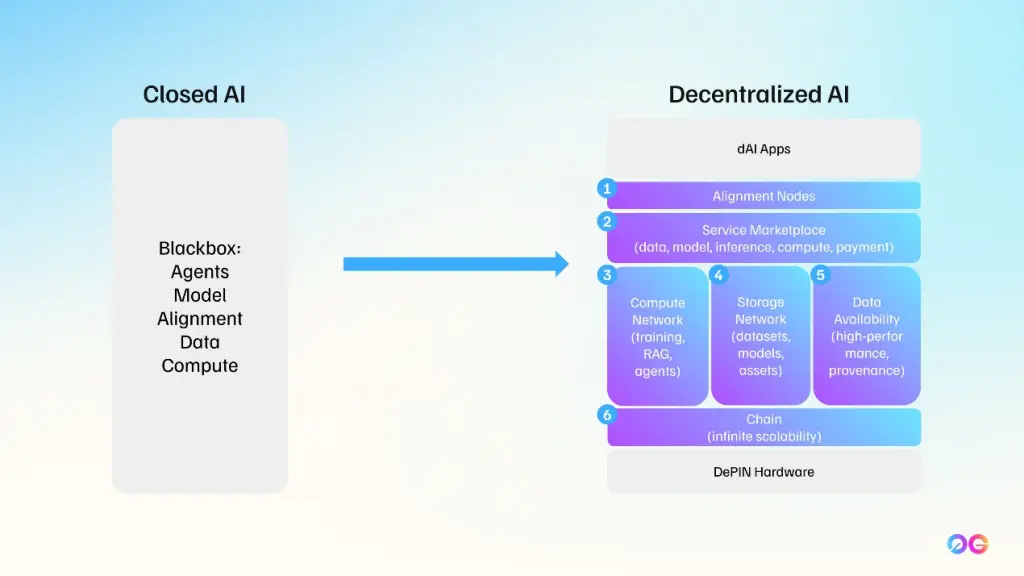
What Is 0G Labs?
In traditional computing, an Operating System (OS) manages hardware and software resources—think Microsoft Windows, Linux, macOS, iOS, or Android. An OS abstracts away the complexity of the underlying hardware, making it easier for both end-users and developers to interact with the computer.
By analogy, the 0G OS aspires to fulfill a similar role in Web3:
- Manage decentralized storage, compute, and data availability.
- Simplify on-chain AI application deployment.
Why decentralization? Conventional AI systems store and process data in centralized silos, raising concerns around data transparency, user privacy, and fair compensation for data providers. 0G’s approach uses decentralized storage, cryptographic proofs, and open incentive models to mitigate these risks.
The name “0G” stands for “Zero Gravity.” The team envisions an environment where data exchange and computation feel “weightless”—everything from AI training to inference and data availability happens seamlessly on-chain.
The 0G Foundation, formally established in October 2024, drives this initiative. Its stated mission is to make AI a public good—one that is accessible, verifiable, and open to all.

Key Components of the 0G Operating System
Fundamentally, 0G is a modular architecture designed specifically to support AI applications on-chain. Its three primary pillars are:
- 0G Storage – A decentralized storage network.
- 0G DA (Data Availability) – A specialized data availability layer ensuring data integrity.
- 0G Compute Network – Decentralized compute resource management and settlement for AI inference (and eventually training).
These pillars work in concert under the umbrella of a Layer1 network called 0G Chain, which is responsible for consensus and settlement.
According to the 0G Whitepaper (“0G: Towards Data Availability 2.0”), both the 0G Storage and 0G DA layers build on top of 0G Chain. Developers can launch multiple custom PoS consensus networks, each functioning as part of the 0G DA and 0G Storage framework. This modular approach means that as system load grows, 0G can dynamically add new validator sets or specialized nodes to scale out.
0G Storage
0G Storage is a decentralized storage system geared for large-scale data. It uses distributed nodes with built-in incentives for storing user data. Crucially, it splits data into smaller, redundant “chunks” using Erasure Coding (EC), distributing these chunks across different storage nodes. If a node fails, data can still be reconstructed from redundant chunks.
Supported Data Types
0G Storage accommodates both structured and unstructured data.
- Structured Data is stored in a Key-Value (KV) layer, suitable for dynamic and frequently updated information (think databases, collaborative documents, etc.).
- Unstructured Data is stored in a Log layer which appends data entries chronologically. This layer is akin to a file system optimized for large-scale, append-only workloads.
By stacking a KV layer on top of the Log layer, 0G Storage can serve diverse AI application needs—from storing large model weights (unstructured) to dynamic user-based data or real-time metrics (structured).
PoRA Consensus
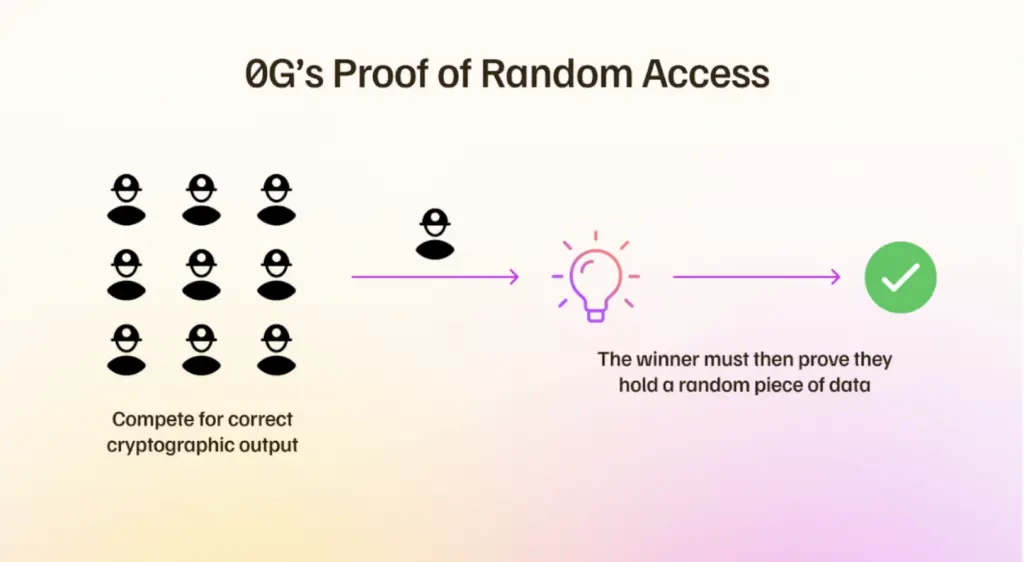
PoRA (Proof of Random Access) ensures storage nodes actually hold the chunks they claim to store. Here’s how it works:
- Storage miners are periodically challenged to produce cryptographic hashes of specific random data chunks they store.
- They must respond by generating a valid hash (similar to PoW-like puzzle-solving) derived from their local copy of the data.
To level the playing field, the system limits mining competitions to 8 TB segments. A large miner can subdivide its hardware into multiple 8 TB partitions, while smaller miners compete within a single 8 TB boundary.
Incentive Design
Data in 0G Storage is divided into 8 GB “Pricing Segments.” Each segment has both a donation pool and a reward pool. Users who wish to store data pay a fee in 0G Token (ZG), which partially funds node rewards.
- Base Reward: When a storage node submits valid PoRA proofs, it gets immediate block rewards for that segment.
- Ongoing Reward: Over time, the donation pool releases a portion (currently ~4% per year) into the reward pool, incentivizing nodes to store data permanently. The fewer the nodes storing a particular segment, the larger the share each node can earn.
Users only pay once for permanent storage, but must set a donation fee above a system minimum. The higher the donation, the more likely miners are to replicate the user’s data.
Royalty Mechanism: 0G Storage also includes a “royalty” or “data sharing” mechanism. Early storage providers create “royalty records” for each data chunk. If new nodes want to store that same chunk, the original node can share it. When the new node later proves storage (via PoRA), the original data provider receives an ongoing royalty. The more widely replicated the data, the higher the aggregate reward for early providers.
Comparisons with Filecoin and Arweave
Similarities:
- All three incentivize decentralized data storage.
- Both 0G Storage and Arweave aim for permanent storage.
- Data chunking and redundancy are standard approaches.
Key Differences:
- Native Integration: 0G Storage is not an independent blockchain; it’s integrated directly with 0G Chain and primarily supports AI-centric use cases.
- Structured Data: 0G supports KV-based structured data alongside unstructured data, which is critical for many AI workloads requiring frequent read-write access.
- Cost: 0G claims $10–11/TB for permanent storage, reportedly cheaper than Arweave.
- Performance Focus: Specifically designed to meet AI throughput demands, whereas Filecoin or Arweave are more general-purpose decentralized storage networks.
0G DA (Data Availability Layer)
Data availability ensures that every network participant can fully verify and retrieve transaction data. If the data is incomplete or withheld, the blockchain’s trust assumptions break.
In the 0G system, data is chunked and stored off-chain. The system records Merkle roots for these data chunks, and DA nodes must sample these chunks to ensure they match the Merkle root and erasure-coding commitments. Only then is the data deemed “available” and appended into the chain’s consensus state.
DA Node Selection and Incentives
- DA nodes must stake ZG to participate.
- They’re grouped into quorums randomly via Verifiable Random Functions (VRFs).
- Each node only validates a subset of data. If 2/3 of a quorum confirm the data as available and correct, they sign a proof that’s aggregated and submitted to the 0G consensus network.
- Reward distribution also happens through periodic sampling. Only the nodes storing randomly sampled chunks are eligible for that round’s rewards.
Comparison with Celestia and EigenLayer
0G DA draws on ideas from Celestia (data availability sampling) and EigenLayer (restaking) but aims to provide higher throughput. Celestia’s throughput currently hovers around 10 MB/s with ~12-second block times. Meanwhile, EigenDA primarily serves Layer2 solutions and can be complex to implement. 0G envisions GB/s throughput, which better suits large-scale AI workloads that can exceed 50–100 GB/s of data ingestion.
0G Compute Network
0G Compute Network serves as the decentralized computing layer. It’s evolving in phases:
- Phase 1: Focus on settlement for AI inference.
- The network matches “AI model buyers” (users) with compute providers (sellers) in a decentralized marketplace. Providers register their services and prices in a smart contract. Users pre-fund the contract, consume the service, and the contract mediates payment.
- Over time, the team hopes to expand to full-blown AI training on-chain, though that’s more complex.
Batch Processing: Providers can batch user requests to reduce on-chain overhead, improving efficiency and lowering costs.
0G Chain
0G Chain is a Layer1 network serving as the foundation for 0G’s modular architecture. It underpins:
- 0G Storage (via smart contracts)
- 0G DA (data availability proofs)
- 0G Compute (settlement mechanisms)
Per official docs, 0G Chain is EVM-compatible, enabling easy integration for dApps that require advanced data storage, availability, or compute.
0G Consensus Network
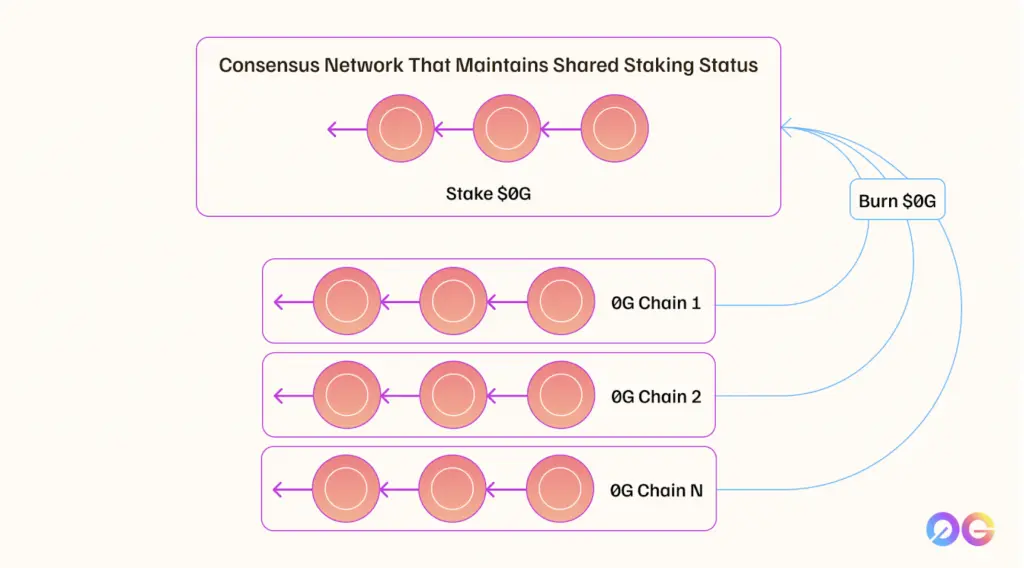
0G’s consensus mechanism is somewhat unique. Rather than a single monolithic consensus layer, multiple independent consensus networks can be launched under 0G to handle different workloads. These networks share the same staking base:
- Shared Staking: Validators stake ZG on Ethereum. If a validator misbehaves, their staked ZG on Ethereum can be slashed.
- Scalability: New consensus networks can be spun up to scale horizontally.
Reward Mechanism: When validators finalize blocks in the 0G environment, they receive tokens. However, the tokens they earn on 0G Chain are burned in the local environment, and the validator’s Ethereum-based account is minted an equivalent amount, ensuring a single point of liquidity and security.
0G Token (ZG)
ZG is an ERC-20 token representing the backbone of 0G’s economy. It’s minted, burned, and circulated via smart contracts on Ethereum. In practical terms:
- Users pay for storage, data availability, and compute resources in ZG.
- Miners and validators earn ZG for proving storage or validating data.
- Shared staking ties the security model back to Ethereum.
Summary of Key Modules
0G OS merges four components—Storage, DA, Compute, and Chain—into one interconnected, modular stack. The system’s design goal is scalability, with each layer horizontally extensible. The team touts the potential for “infinite” throughput, especially crucial for large-scale AI tasks.
0G Ecosystem
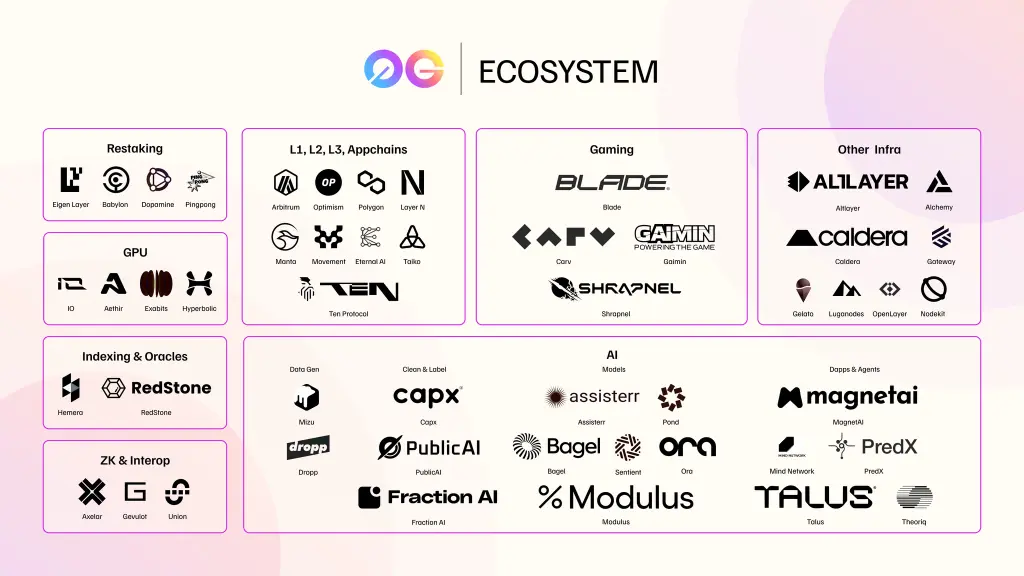
Although relatively new, the 0G ecosystem already includes key integration partners:
-
Infrastructure & Tooling:
- ZK solutions like Union, Brevis, Gevulot
- Cross-chain solutions like Axelar
- Restaking protocols like EigenLayer, Babylon, PingPong
- Decentralized GPU providers IoNet, exaBits
- Oracle solutions Hemera, Redstone
- Indexing tools for Ethereum blob data
-
Projects Using 0G for Data Storage & DA:
- Polygon, Optimism (OP), Arbitrum, Manta for L2 / L3 integration
- Nodekit, AltLayer for Web3 infrastructure
- Blade Games, Shrapnel for on-chain gaming
Supply Side
ZK and Cross-chain frameworks connect 0G to external networks. Restaking solutions (e.g., EigenLayer, Babylon) strengthen security and possibly attract liquidity. GPU networks accelerate erasure coding. Oracle solutions feed off-chain data or reference AI model pricing.
Demand Side
AI Agents can tap 0G for both data storage and inference. L2s and L3s can integrate 0G’s DA to improve throughput. Gaming and other dApps requiring robust data solutions can store assets, logs, or scoring systems on 0G. Some have already partnered with the project, pointing to early ecosystem traction.
Roadmap & Risk Factors
0G aims to make AI a public utility, accessible and verifiable by anyone. The team aspires to GB/s-level DA throughput—crucial for real-time AI training that can demand 50–100 GB/s of data transfer.
Co-founder & CEO Michael Heinrich has stated that the explosive growth of AI makes timely iteration critical. The pace of AI innovation is fast; 0G’s own dev progress must keep up.
Potential Trade-Offs:
- Current reliance on shared staking might be an intermediate solution. Eventually, 0G plans to introduce a horizontally scalable consensus layer that can be incrementally augmented (akin to spinning up new AWS nodes).
- Market Competition: Many specialized solutions exist for decentralized storage, data availability, and compute. 0G’s all-in-one approach must stay compelling.
- Adoption & Ecosystem Growth: Without robust developer traction, the promised “unlimited throughput” remains theoretical.
- Sustainability of Incentives: Ongoing motivation for nodes depends on real user demand and an equilibrium token economy.
Conclusion
0G attempts to unify decentralized storage, data availability, and compute into a single “operating system” supporting on-chain AI. By targeting GB/s throughput, the team seeks to break the performance barrier that currently deters large-scale AI from migrating on-chain. If successful, 0G could significantly accelerate the Web3 AI wave by providing a scalable, integrated, and developer-friendly infrastructure.
Still, many open questions remain. The viability of “infinite throughput” hinges on whether 0G’s modular consensus and incentive structures can seamlessly scale. External factors—market demand, node uptime, developer adoption—will also determine 0G’s staying power. Nonetheless, 0G’s approach to addressing AI’s data bottlenecks is novel and ambitious, hinting at a promising new paradigm for on-chain AI.